
Capture First, Judge Later
contents
Two jobs that shouldn’t share a room
The single biggest thing that killed my writing output was doing two jobs at once. I’d think of an idea and immediately judge it. The thought and the verdict arrived together, so nothing survived long enough to develop. It took me embarrassingly long to see the obvious fix: generating ideas and evaluating ideas are different jobs, and they don’t belong in the same moment.
When you capture and critique simultaneously, the critic always wins, because the critic is faster and more confident. So you end up with a tidy, empty page and a vague sense that you have no good ideas. You have plenty. You’re just killing them at birth.
What this solves
- Names why mixing generation and judgment kills output.
- Reframes the inner critic as useful, but only at the right time.
- Gives a simple loop that turns scattered notes into actual drafts.
The inner critic is useful, just not during capture
The critic isn’t your enemy. A piece of writing with no editing is a mess, and the part of you that says “this is unclear, cut it” is doing real, necessary work. The mistake isn’t having a critic. It’s letting it run during capture, when its only job should be to stay quiet.
Capture mode has one rule: catch everything, judge nothing. A half-formed idea, a weird connection, a sentence that might be dumb, all of it goes in the net. You are explicitly not deciding whether it’s good. You’re just making sure it exists. The evaluation happens later, in a completely separate pass, when you’re cold and ruthless instead of warm and generative.
I think of them as two different employees who should never be in the room at the same time. The generator is enthusiastic and indiscriminate. The editor is skeptical and precise. Both are valuable. Put them in a meeting together and they cancel each other out.
Why do more candidates produce better work?
Because selection beats invention. You don’t get one great idea by demanding greatness up front. You get it by generating a big pile of mediocre candidates and picking the best one. The quality of your output is downstream of how much raw material you let yourself produce, and raw material only piles up if you stop pre-judging it.
This is the part the perfectionist instinct gets exactly wrong. It wants the first idea to be the keeper, which sets the bar so high that you generate almost nothing. But ten okay ideas give you a better starting point than zero perfect ones, because you can combine, cut, and refine ten. You can’t refine nothing. More candidates means a better top choice, almost mechanically.
My content idea bank is the meta-example here. It’s a running file of post angles, most of which are not good. That’s the point. This batch of posts came out of a list far longer, and it could only get that long because I’d banned myself from judging entries as I added them. The LLM in my music pipeline does the same thing with very different material: it treats the noisy output as a feature, not a bug, because more candidates means a better top choice.
Atomic notes keep ideas reusable
The form your captures take matters. If every idea is tangled inside a long, context-heavy note, it can’t travel. The trick is to keep ideas atomic: one clear idea per note, written so it can be linked from multiple places without rewriting it. Then a single idea can show up in three different drafts instead of being trapped in the one place you first wrote it.
The test I use is simple. Can this note express one main idea cleanly? Could I link it from a context I haven’t thought of yet? If yes, it’ll compound. If an idea is fused to a specific post, it dies with that post. If it’s atomic, it becomes a reusable part. The friendship-and-repetition idea from another post I’m writing started as a standalone note, which is exactly why it could slot in cleanly when I needed it.
The goal isn’t tiny notes for their own sake. It’s ideas that combine. Atomic notes are just the form that makes recombination easy, and recombination is where most of the interesting work actually happens.
The idea bank should push toward drafts, not hoarding
The failure mode I have to actively fight: the idea bank becomes a hoard. You capture and capture, the file swells, and it starts to feel like progress. It isn’t. A note nobody ever drafts from is just a tidy graveyard. The system has to bias toward output, or it quietly turns into productive-feeling procrastination.
So I treat the bank as a feeder, not a destination. Its whole purpose is to make starting a draft easier than starting from a blank page. If a pile of notes never gets pulled into something published, that pile failed, no matter how organized it looks. The metric isn’t how many ideas I’ve captured. It’s how many made it out the door.
That reframe keeps me honest. Capture is cheap and feels great. Drafting is harder and is the actual point. The bank exists to serve the draft, never the reverse.
The loop: capture, connect, select, draft, publish
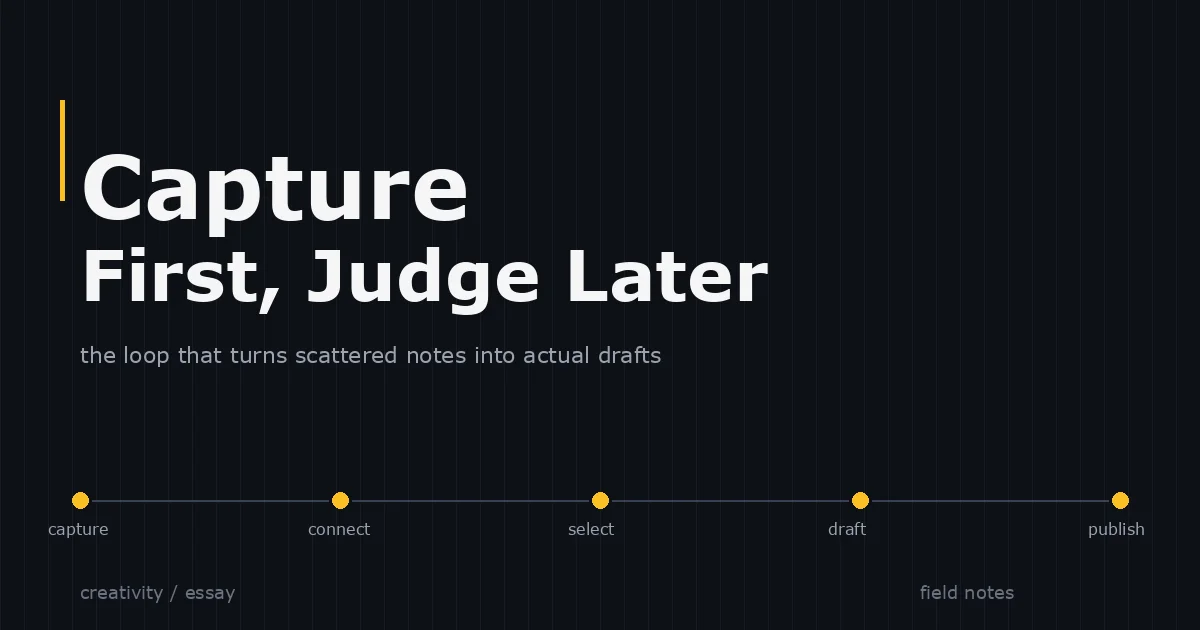
Here’s the whole thing as one cycle. Capture without judging, all day, into a low-friction net. Connect later, linking related notes so ideas find each other. Select in a cold, separate pass, where the critic finally gets to do its job and pick what’s worth building. Draft from the selected material, fast and ugly, letting the generator run again. Publish, which is the step that makes the whole loop real, the moment a draft stops being private and earns its place in public.
Each stage has its own mode, and keeping them separate is most of the skill. The generator runs during capture and drafting. The critic runs during select and edit. Mix them and you stall. Sequence them and the work flows. The reason this matters is the same reason deliberate friction beats easy defaults: the easy path is to skip the capture, and the blank page is brutal — a full idea bank means you almost never face one.
So if your output feels stuck, check whether you’re judging too early. My guess is the ideas were there. They just never got a quiet moment to exist before the critic showed up. Give them that moment, separate the jobs, and watch how much more material you suddenly have to work with.